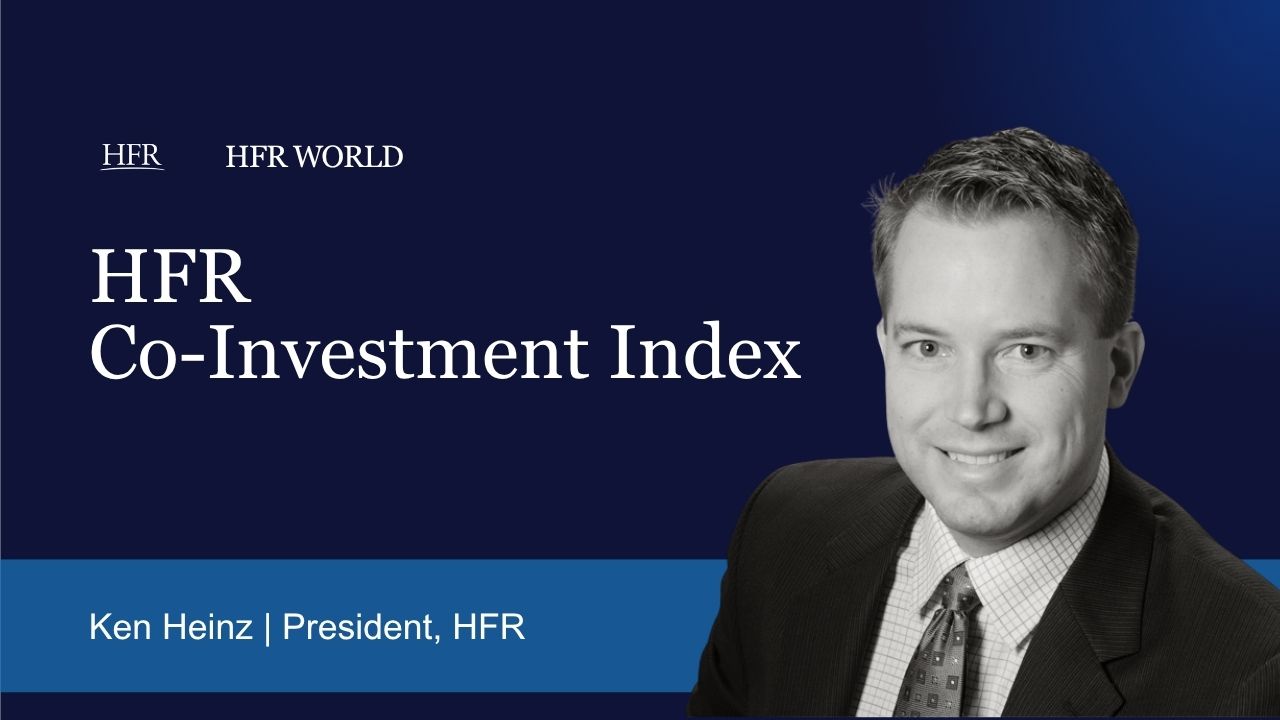
HFR Podcast: Global Hedge Fund Industry Report 2026 Q2
The hedge fund industry is setting new records!
Join us as Ken Heinz, President of HFR Index discusses what has driven this performance and unprecedented asset inflows. Our discussion is based on the HFR Global Hedge Fund Industry Report 2026 Q2, which has just been released. Alongside discussing past performance, Ken also shares his outlook for which strategy areas he will watch closely in the second half of the year given economic expectations and the outlook for markets.
Key Takeaways
- Hedge funds saw over $400 billion in quarterly asset growth in Q2 2026
- Technology sector strategies outperformed the Nasdaq by 600 basis points.
- Anti-beta and anti-crowded trades are gaining prominence.
- Event-Driven and Relative Value Arbitrage strategies are expected to perform well in H2 2026.
Chapters
00:00 Introduction to Hedge Fund Industry Highlights
01:11 Record Asset Growth and Market Environment in 2026
02:41 Performance of Substrategies and Key Winners
04:53 Impact of AI on Market Dynamics and Hedge Fund Strategies
07:43 Interest Rate Outlook and Geopolitical Risks
09:05 Strategies to Watch for the Second Half of 2026
10:22 Closing Remarks and Industry Outlook
Resources
Get your copy of the HFR Global Hedge Fund Industry Report 2026 Q2
LinkedIn – https://linkedin.com/in/kenheinz
Transcript
S. Aneeqa Aqeel (00:00)
Welcome back to HFR World. We are excited to bring you an overview of the hedge fund industry from HFR’s Global Hedge Fund Industry Report for 2026 second quarter. Ken Heinz Heinz, President HFR Index, welcome back to the show.
Ken Heinz (00:16)
Thanks for having me on.
S. Aneeqa Aqeel (00:17)
So Ken, we know that hedge funds have had a pretty good first half of the year so far. What particular insights and areas of strength does the Global Report identify?
Ken Heinz (00:28)
Yeah, I would go so far to say that it’s it was an amazing first half and an amazing second quarter for the industry. And the real evidence of that is the multiple records that were set with the growth in the second quarter. One of the most exciting is that the actual amount of asset growth, over $400 billion, is the single largest quarterly asset growth in history. Inflows also set a record, and total industry assets had a huge jump from 5.2 trillion, which was a record at the end of the first quarter, to over 5.6. Just a huge, huge increase and a huge, huge record. But what I I think is really most exciting about all of these records, Aneeqa, is that all of this happened in what was really, I mean, there were good periods in the second quarter, but it was overall, the first half of the year has been a pretty mixed environment. It’s not like 2019 where everything went up. You have a essentially a mixed market. You know, equities were up, yeah, 10% or so for the S&P and for the the Dow Jones. NASDAQ was up a little bit more. But rates, you know, people came into the year expecting much lower rates. Now they’re not expecting that at all. Commodities have been volatile, up, down, up, down consistently. And overall, when you think about the geopolitical environment and what to expect going forward, it’s significantly unclear what people should really realistically be positioning for in the second half of the year.
S. Aneeqa Aqeel (02:12)
So I want to understand obviously huge inflows into hedge funds. How does performance bear this out and how has performance in sub-strategies provided nuance to overall performance numbers?
Ken Heinz (02:17)
Yeah.
Exactly.
Exactly. It’s been great. I’ll start off with the best performing area. It’s not going to surprise anybody to say that it’s the HFRI Technology substrategy, which is of course within Equity Hedge. But what’s interesting about that, it’s two bylines that I would put on top of that. One, the HFRI Technology Index significantly outperformed the Nasdaq by the tune of 600 basis points in the first half of the year. And then similarly, Fundamental Growth gained 16.3%, also well ahead of the NASDAQ gain itself. But what’s even more interesting than that is if you break out the most concentrated areas of the NASDAQ, which for the last five years we’ve been talking about the Mag 7 stocks.
That’s no longer the trade. Those were only up a very small amount for the whole year, and some of those names are actually down. So the story is anti-beta, anti-crowded trades. That’s really what’s going on. Two other areas that you can’t miss in terms of performance is very quietly, we didn’t have a lot of talk about people going distressed or going out of business, but those funds had a very strong first half of the year to the tune of 13.4%. In addition, another area that’s energy related, but not only energy stocks, is what we call Yield Alternatives. And it falls in the relative value arbitrage space, Yield Alternatives. These gained 16.3%. And some There’s quite a number of you know positive carry type of things a lot of them are energy related because they’re energy infrastructure MLP, master limited partnerships and things like that – it’s kind of a multi strategy of things that that produce yield and they had a really great first half of the year.
S. Aneeqa Aqeel (04:23)
How do you perceive the hedge fund industry going forward to be navigating AI driven equity market gains and expectations into the second half of the year?
Ken Heinz (04:33)
It’s a great question because my most honest answer is that the trade is so big that it’s kind of mind-boggling to think about quite how big it actually is when you think about how many ways that the AI trade impacts financial market performance and how at how many different levels. But the one thing that we’ve learned. I mean, I think we kind of knew it before, but it’s been borne out by evidence in the first half of the year, is that despite the vision and the size and the potential down the road, there absolutely will be periods of risk-off where people really question how soon all of the spending that’s happening is going to deliver profits for these companies. And so that’s where having hedge fund exposure to the space is really, really valuable because you’re going to have the double and half, and double and half in a lot of these really volatile equities. And it it takes a specialized trade to really be able to navigate that kind of volatility.
S. Aneeqa Aqeel (05:40)
So speaking of volatility, there’s high likelihood of a Fed rate hike in the future and there’s ongoing inflation due to the sustained military conflict in the Middle East. Which strategy areas do you expect will remain dominant in the rest of the year? And are there any particular white knights hiding in the wings coming to rescue the economy?
Ken Heinz (06:01)
That’s a great question. You know, there’s a lot of talk about interest rates. Like I said, you know, if you go back to the beginning of the year, I think people thought three, four, five interest rate cuts in 2026. Now, as you say, the sentiment has shifted. The world’s changed a lot. Inflation’s persistent. Oil is volatile, and prices are not lowered. People are positioning for interest rate increases. I think there is a low ceiling. You may get an interest rate increase, but I think the Fed will really try to hold steady as much as possible. And under that scenario, or the most likely outcome in coming months, and again, it’s really hard to say anything’s likely in the current environment, is that you see equities flatline, oil fall, gold potentially go up, IPOs continue, and interest rates, you know, maybe a little bit higher, maybe a little bit lower, not significantly changed. In that scenario, which again, there’s a lot of conditions, what strategies do I think would perform in the second half of the year?
I would put money on Event Driven. I think with the IPO market and everything that we see going on, and M&A, I think that’s going to deliver a lot of strong performance without the necessity of equity market beta or small cap equity market beta, which can be extremely volatile. Number two, I would say Relative Value Arbitrage. If we do see this interest rate environment prevailing that we talk about slightly higher and then maybe falling back depending on what happens with oil. I think those strategies can do very, very well. And like I we talked earlier about the Yield Alternatives and the fact that they’re up very quietly up 16 and change percent. Thirdly, I like Macro and I I still like all four strategies this year. I like Macro. I do think that I would like it more after a very sharp decline in oil because I think if you get into Macro now and you see a very sharp decline if the hostilities in geopolitical and oil could fall sharply. And then finally, I’m not hating on Equity Hedge as the leading area of performance in the first half of the year. So I think it’s still going to do very well. I just think that as far as the four strategies go, that would be my choice for the fourth.
S. Aneeqa Aqeel (08:23)
Excellent. Thank you for sharing your insight as always. And for the brief glimpse into the Global Hedge Fund Industry Report, which is out from HFR now. You can sign up and register at HFR.com to obtain your copy. Thank you for joining us, Ken.
Ken Heinz (08:39)
Thank you.
Important Information About This Content
HFR is the global leader for hedge fund data and indices in the financial world. The HFR Podcast features interviews with allocators and subject experts. Find us on Spotify, LinkedIn, X, and YouTube.
Contact us at hfrmedia@hfr.com
DISCLAIMER: The opinions shared in this video are those of the individuals featured and do not reflect any interest, recommendation, or policy of HFR or its subsidiaries. HFR has no obligation to provide revised assessments in the event of changed circumstances. HFR cannot guarantee the accuracy of the information provided. This material may contain “forward-looking statements” including projections, estimates, and information about possible or future results related to market or recent developments. No portion of this webinar may be published, reproduced, transmitted or rebroadcasted in any media in any form without the express written permission of HFR. © 2026 HFR, Inc., all rights reserved. HFR®, HFRI®, HFRX®, HFR.COM™ and HEDGE FUND RESEARCH™ are the trademarks of Hedge Fund Research, Inc.
More Recent Media
View All Media
HFR World: HFR Interval Funds and Tender Offer Funds Indices
HFR World In this episode of HFR World, Ken Heinz and S. Aneeqa Aqeel introduce the newly launched Interval Funds and Tender Offer Funds index families, highlighting their importance in…
HFR World: Global Hedge Fund Industry Report 2026Q1
Join us as we discuss the latest intelligence on industry asset flows, best performing strategies, and areas of opportunities in the short term for the hedge fund industry. The HFR…