
HFR Podcast: U.S. Treasury Markets – Evolving Risks & Rates, with Jill Cetina
In this episode, Jill Cetina from Texas A&M Mays Business School discusses the implications of recent Treasury bond buybacks, market reactions, and the broader macroeconomic and geopolitical impacts. She offers insights into how these policies affect hedge funds, market stability, and the US dollar’s role in global finance.
Recording date: September 10th, 2026
Keywords
Treasury bond buyback, market liquidity, hedge funds, macroeconomy, US dollar, petrodollar, interest rates, fiscal dominance, geopolitical risk, Strait of Hormuz, Red Sea
Chapters
00:00 Introduction to Treasury Bond Buybacks and Market Reaction
00:14 Critique of Long-Dated Bond Buyback Programs
00:17 Market Liquidity and the Role of the Treasury Market
00:34 Impact of Shortening the Weighted Average Maturity
00:51 Risks of Rising Yields and Market Volatility
01:00 Hedge Funds’ Exposure to Treasury Market Shocks
01:08 The Influence of Geopolitical Events on US Debt and Dollar
01:31 The Petrodollar System and Its Geopolitical Significance
01:55 Policy Recommendations for Treasury and Fiscal Management
tRANSCRIPT
S. Aneeqa Aqeel (00:00)
Welcome to the HFR podcast. Today we’re delighted to welcome back Jill Cetina of Texas A&M Mays Business School. She’s an executive professor of finance and an authority on banking supervision and Treasury markets. Jill, welcome back to the show.
Jill Cetina (00:14)
Aneeqa thank you for inviting me back. It’s wonderful to be back with you.
S. Aneeqa Aqeel (00:17)
So today the Treasury bought back $6 billion worth of long-dated bonds. And upon announcement of this figure yesterday, yields rose. The price response was understood to be driven largely because of disappointment in the market that it wasn’t a bigger buyback still.
When I look at Scott Bessent’s argument for the Treasury buybacks, he has effectively said, you know, it’s going to be a liquidity injection into the economy. And the hope is it basically crowds in private investment so that we can grow our way out of debt as an economy.
Do you think that this fiscal action actually does help or will it introduce additional risk into the macroeconomy?
Jill Cetina (01:00)
So I’ve been a critic of both buybacks and shortening the weighted average maturity of the Treasury market since that practice began actually under Treasury Secretary Yellen. Okay. So I think it’s important to recognize that the these tools started under the prior administration, and now unfortunately, we’re seeing their excess use play out under this administration. What are a couple of thoughts first on the on the buyback program, Aneeqa?
You made a comment that you know the I’ll call it whisper number as I understand it around the amount that would be announced was actually bigger in the market than six billion. And so there was you know, I’ll call it a disappointment trade, but this whole dynamic of announcing outside of a quarterly refunding that we were going to expand liquidity buybacks of the long end is a departure from regular and predictable and implies seemingly to markets that there is some yield level in terms of long-term interest rates that is not, I’ll use the word acceptable.
And therefore, we want to in some fashion intervene. I would argue when this buyback program began, we had buyback programs when we were running budget surpluses. When I was at the Treasury Department, that’s a different ball of wax. That’s a different beast to be doing buybacks when you’re running budget surpluses. We are, you know, so far from that. And again, when we are doing these long-dated buybacks, we are buying back at the risk of being again obvious for folks who are hedge hedge fund managers, but we are buying back debt that is basically at a discount. This is debt that has coupons that are below market. And we are refinancing that more towards the front of the curve.
And implicitly in that has got to be an assumption that rates are going to fall in the future for this to be a useful strategy. Now you can get into more I’ll say sophisticated arguments about this buyback program, like does the buyback program you know improve market liquidity and make dealers more I’ll say, open to bidding aggressively at auction, knowing that there will be the Treasury potentially providing liquidity in the secondary market.
But we’re only providing liquidity in the secondary market if yields are rising. We are not, we don’t have facilities if you know something is trading special at the long end. So you know the Treasury market is among advanced economies the biggest government bond market in the world. And to me, the regular and predictable mantra that, you know, some people may find boring or they might say, well, you know, some small countries’ debt manager, they they do these more activist type of approaches on debt management, that’s not relevant.
This is like, you know, the Treasury market is like a super tanker, right? People are trying to in some fashion act like it’s a speedboat. I just hope that we don’t I’ll say double down on this type of policy approach. And just accept if yields are rising, because you know, there’s there’s a number of things we can unpack there. But you know the rise in yields has a fundamental basis behind it. Certainly we can see the fundamental basis relating to what’s happening in commodity prices. You know real yields are are reflecting back to the Treasury, the fact that, you know, basically the Fed and other central banks need to raise interest rates in light of this commodity price shock that is already unfolding and appears to still be unfolding.
S. Aneeqa Aqeel (04:43)
Right. And so I guess there’s a couple of things you said that I want to unpack. So I think given the size of the Treasury market, is it even realistic to try and refinance the government debt basically with lower rates, right? Is the government more nimble by doing this? By switching to shorter horizon borrowing?
Jill Cetina (05:04)
Again, you’d have to believe that rates are falling in the future, right? And that implicitly puts some potential pressure on the Fed. The more the Treasury funds itself at the front end, the more I’ll say implicit pressure there is you know, for the Fed to potentially take that into consideration. Now I believe that obviously we’ve got a number of FOMC members who’ve started to dissent and express concern about inflation remaining above target for so long and and seeking to raise the Federal Funds Rate. But one consequence of shortening the WAM, the weighted average maturity, in this fashion, is to create or to risk to create some positive feedback loops in terms of you know inflation and the Fed’s work in terms of setting short-term interest rates.
So borrowing across the curve for a large economy like the US is a healthy discipline. And if we’re having difficulty funding ourselves across the curve, then we need to have a hard rethink of about fiscal policy. That’s way overdue. But you know, acting like the debt management can, I’ll say, soften that seems to me unrealistic.
S. Aneeqa Aqeel (06:17)
Okay. So I’ll probably circle back to this in a minute. I want to focus on what this will mean for hedge funds in particular, especially because so far this year it’s been pretty lucrative. The HFRI substrategies index, Relative Value: Yield Alternatives, which are focused on the basis trade and other such trades, has a cumulative gain of 16.5% year to date.
So now we have two shocks in the system where you have concerted Treasury action to reduce the duration of government borrowing, and you have direct intervention in the yen market, ostensibly to stave off foreign dumping of US Treasuries. How does this directly impact these highly leveraged hedge funds in the Treasury market and therefore the rest of us?
Jill Cetina (07:06)
Well. I mean, I think the fact that we’ve had and many commentators have remarked on this, but such a growth in the basis trade. What is it? The basis trade has grown like in the last five years, by a factor of three, I think it is. I was reading a piece written by my colleagues at the Office of Financial Research where I worked previously as well. But you know, the fact that you’ve had so much growth in the basis trade, Aneeqa, and hedge funds as we all know are very marked to market sensitive, these are leveraged trades. So you know, shocks to the Treasury market have, of course, the potential for causing even larger moves in the Treasury market as a result of these leveraged trades. And I would also make a point here that I’ve made to my own students so if any of them are watching this I’ll say it here again. you know as volatility rises for any asset, that implies its price should be lower. So think about the 10-year Treasury yield. The more hedge funds that we have doing the basis trade, and you know that implies by virtue of their marked-to-market price sensitivity, more vol. And that should actually raise the level of yields itself, right?
So I think sometimes people think about these things as in in kind of disconnected fashion. Volatility, the volatility regime itself influences the rate regime. And I think because the Treasury market is having to rely more on these price sensitive investors, and we haven’t even gotten into the topic of how the Middle East may change demand for dollars and demand therefore for Treasuries. But this means to me that we’re going to be in a higher rate regime, this increased vol.
S. Aneeqa Aqeel (08:51)
And are you able to say what hedge funds might or should be doing differently from a risk management perspective?
Jill Cetina (08:57)
I mean scenario analysis is always your friend. You know, thinking about again, you know, risk limits. I will say when it comes to the topic of risk limits, both what happened over the summer with Situational Awareness and with Jane Street. and you know Jane Street obviously has had a very profitable trading record, but that was quite a large loss that it took. It has caused me to wonder whether as we go into the fall, whether prime brokers may say tighten up in terms of liquidity provision and really focusing in on the marked to market position of counterparties. And so I guess one piece of advice I might give is that you know it’s plausible to expect that prime brokers may tighten conditions and be a lot stickier in terms of dealing with hedge funds and other levered counterparties in terms of you know where they are marked to market. So if you’ve gotten grace in the past at your fund, I might not expect it as we move ahead from here.
S. Aneeqa Aqeel (10:01)
Circling back to the Treasury and its shaping of market sentiment and prices, what piece of advice would you offer Treasury Secretary Bessent at this point in time?
Jill Cetina (10:13)
I think that first and foremost we need to recognize that the back end is having difficulty from a cyclical viewpoint because inflation has been allowed to be high for too long.
And so you know, inflation can be dealt with either by the Fed or it can be dealt with through fiscal policy. And running a tighter fiscal policy to be very specific about it. You know, obviously as Treasury Secretary, you need to bring Congress along,
I think Secretary Bessant tried to come in with I’ll say the right frame of reference with you know talking about trying to narrow the budget deficit to three percent of GDP. But you’ve got to bring people along with you and trying to do that type of a fiscal tightening without Congress, we saw that the Supreme Court ruling on tariffs unraveled that, right? We had half a percentage point of GDP go in as fiscal stimulus due to the tariff refunds in the last quarter, roughly speaking. So I think dealing with the core issue, which is inflation, is going to help the back end, and going back to regular and predictable.
And borrowing across the curve, that would be my advice. And that may not feel as exciting as interacting with markets in this kind of a way, but you know, again, this is when once you take out the Fed, I think we’re talking it’s like 29 trillion in marketable Treasuries. This is an enormous market, and it’s important, I think, to project stability so that we don’t end up with a risk premium in the market.
S. Aneeqa Aqeel (11:44)
And then finally, you just mentioned the Middle East very briefly, and there’s been developments in the Red Sea. How does the petrodollar figure into the direction of the US economy right now and especially also its foreign counterparts? So given our level of inflation and the path of the US dollar itself.
Jill Cetina (12:03)
Right. So I think there are three ways, Aneeqa, to think about the rise in real yields. And we touched on one of them already,
which is the fact that we’ve got this unfolding, you know, shock that, started in the Strait of Hormuz, spread to the Red Sea, and then also we’ve got the events in terms of Ukraine stepping up its response to Russia, who of course attacked it first, and destroying their refineries. And all of this is putting upward pressure on commodity prices and will bring inflation with it.
So that’s like kind of the cyclical story, but there’s also a longer run story, which is you know, if we think back into like the mid-1950s, the British got embroiled with France and Israel in a conflict around the Suez Canal with the Egyptians. And ultimately, you know, they did not prevail in that conflict. That conflict kind of marked one of the steps in their transition away from being the global reserve currency and being the global economic hegemon. And the US, again, this isn’t meant to disrespect anyone in military service, but we are struggling in terms of being able to project power in the Middle East.
And that region we’ve created you know a system, the petrodollar system, that was effectively, the US provides security in the region for shipping. And we have bases in the region that are intended to provide that security. And these countries, many of them have dollar pegs, commodities are priced in dollars. It started with oil and spread to other commodities.
And as a result of their dollar pegs, they also hold Treasuries. And this system has worked well, but now it almost seems like having a base can result in more aggression towards some of these countries. And we’ve not really been able to solve that. And I do think that, the the role of the dollar and the Treasury market are two sides of the same coin, right? So I am concerned that again, I’m you know a professor of finance, I’m not a geopolitical strategist, but when I look at for example, global central bank reserve holdings of dollars, and the IMF reports this, right?
You can see, for example, if you look at that time series, which is available on the IMF’s website, the reserve status of the dollar was going through a period of decline. And then, you know, we had President Bush Senior successfully lead the global coalition to repel Iraq from Kuwait. And that coupled with the end of the Cold War was very dollar positive.
So these perceptions of a country’s ability to I’ll say project power as the global hegemon in the world does affect their reserve currency status and does affect how much of their government securities are held by others and therefore affects interest rates. So we have to, I think, keep that in mind as well, you know, the petrodollar system and its future.
S. Aneeqa Aqeel (15:00)
Absolutely. Well said. Thank you so much for your time. I know you’re traveling. I really appreciate you taking the time to chat with us.
Jill Cetina (15:08)
No, thank you, Aneeqa, and I hope it’s helpful a few of the ideas to your listeners.
Important Information About This Content
The opinions shared in this video are those of the individuals featured and do not reflect any interest, recommendation, or policy of HFR or its subsidiaries.
HFR is the global leader for hedge fund data and indices in the financial world. The HFR Podcast features interviews with allocators and subject experts. Find us on Spotify, LinkedIn, X, and YouTube. Contact us at hfrmedia@hfr.com
HFR has no obligation to provide revised assessments in the event of changed circumstances. HFR cannot guarantee the accuracy of the information provided. This material may contain “forward-looking statements” including projections, estimates, and information about possible or future results related to market or recent developments. No portion of this webinar may be published, reproduced, transmitted or rebroadcasted in any media in any form without the express written permission of HFR Media LLC. © 2026 HFR, Inc., all rights reserved. HFR®, HFRI®, HFRX®, HFR.COM™ and HEDGE FUND RESEARCH™ are the trademarks of Hedge Fund Research, Inc.
More Recent Media
View All Media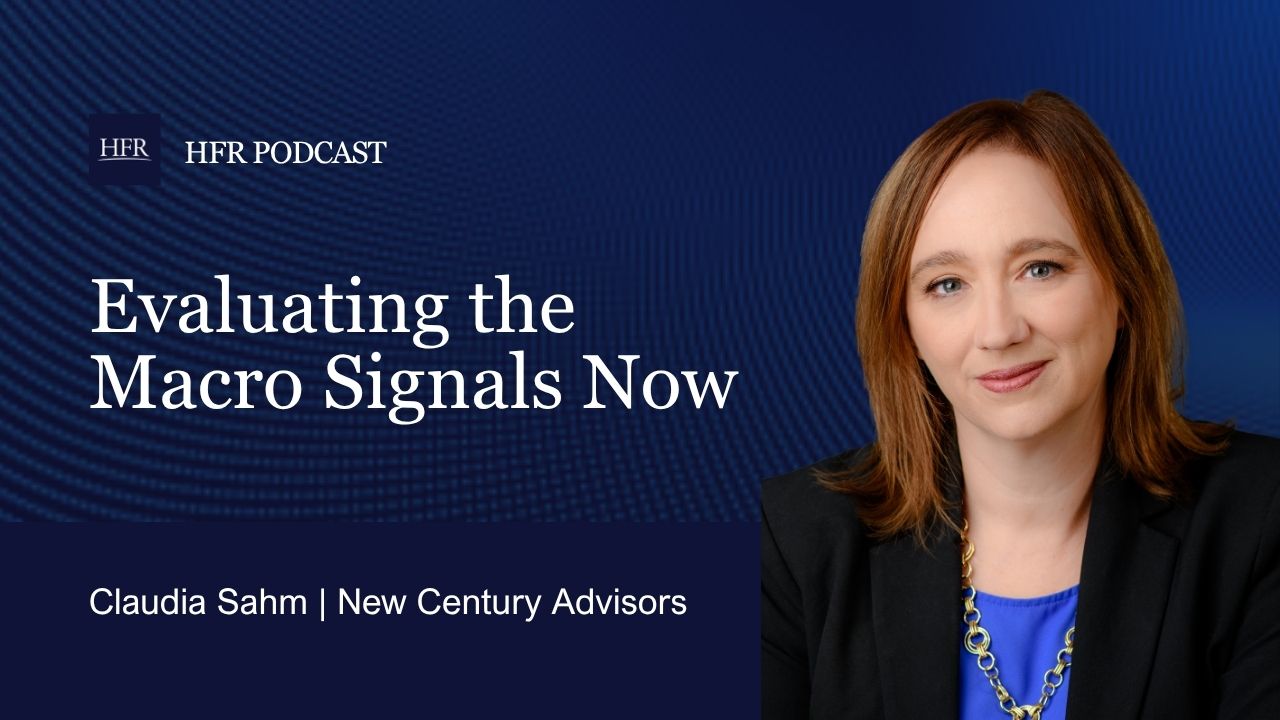
HFR Podcast: Claudia Sahm – Evaluating the Macro Signals Now
In this episode, macroeconomist Claudia Sahm discusses how US jobs, payroll and CPI releases for July 2026 point to structural rather than cyclical change in the labor market. With the…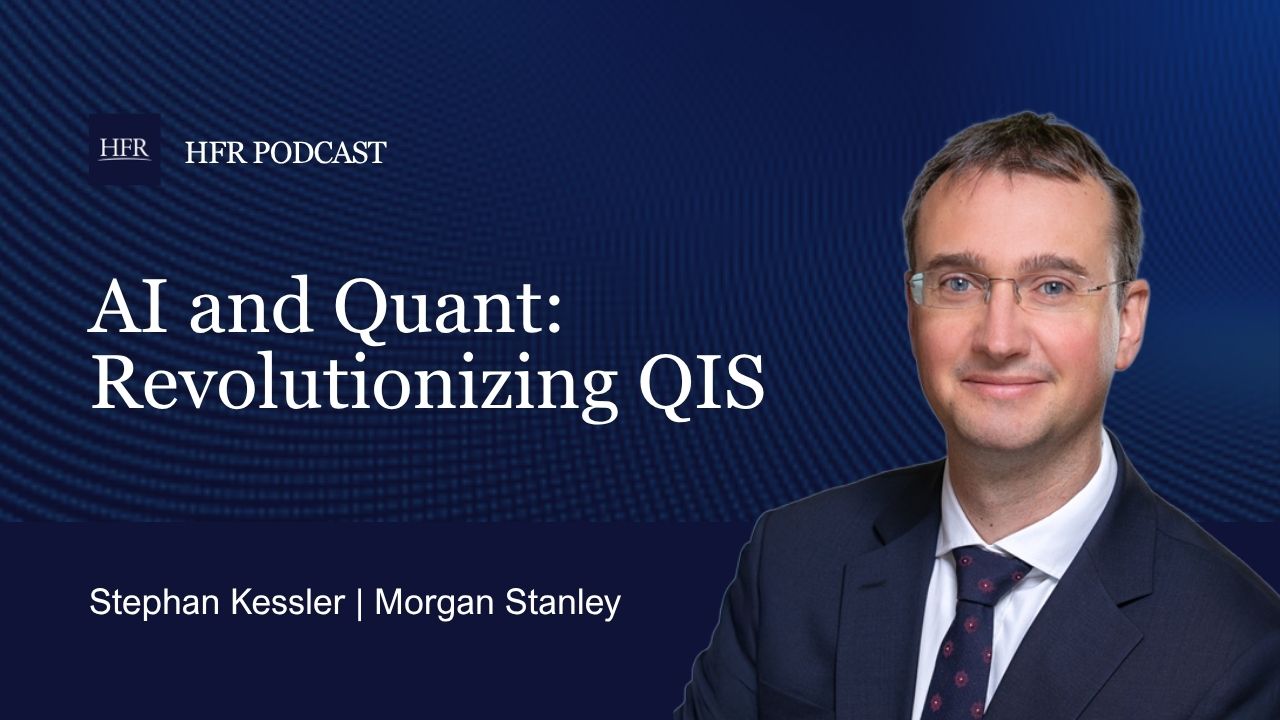
HFR Podcast: AI and Quant – Revolutionizing QIS
In this episode, Stephan Kessler discusses the transformative impact of AI on quantitative investment strategies, signal generation, and portfolio construction, highlighting how AI enhances productivity, signal uniqueness, and alpha generation. …